

 Loading

Whether you’re looking to fuel your business’s growth with expansion, new equipment, improved technology or something else, securing a business loan is a powerful financial tool to help you reach your goals. With so many business lending options available, it’s crucial to pick the right loan to set yourself up for success.
If you’re new to business financing or haven’t needed a loan for some time, choosing the right option can feel overwhelming. NEBAT is here to help with professional insights that break down the basics of business loans to help you explore your options with confidence. Read our step-by-step guide to learn more.
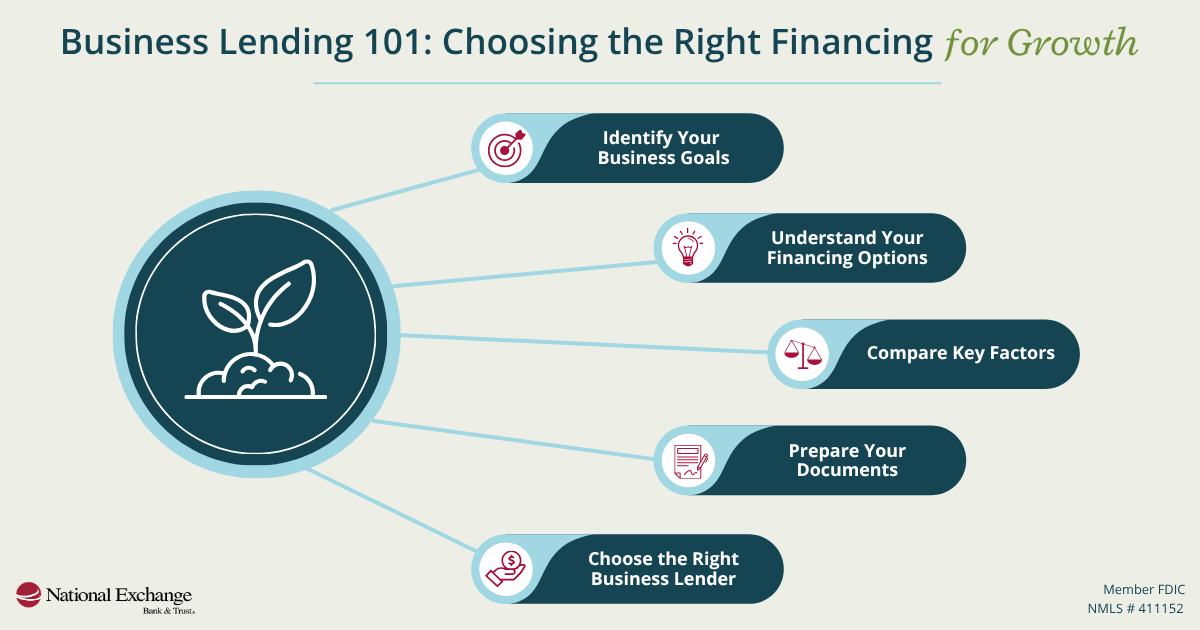
Step 1: Identify Your Business Goals
Start by defining the purpose of your business growth financing. What do you want to do with your business loan? Are you seeking financing for a short-term need, like purchasing inventory or funding a marketing campaign, or are you looking to fund a long-term need, like expanding into a new market or investing in large-scale infrastructure upgrades? There are different financing options available based upon the length of the initiative and loan type.
Next ask yourself: is your funding for a one-time investment, such as real estate, or is it ongoing, such as seasonal fluctuations? One-time investments have a clear endpoint and tangible outcome; they are well suited for plans with a defined repayment schedule. Ongoing working capital needs are recurring and fluctuating, which makes a line of credit the best option.
Once you define these parameters, you are ready to move on to step two.
Step 2: Understand Your Financing Options
Once you have a clear vision of your lending goal, it’s time to explore business financing options. Conducting a simple business loan comparison can help determine which financing solution best fits your needs. There are a number of possibilities available to business owners including:
Working Capital Line of Credit
A Working Capital Line of Credit is a flexible form of financing that grants you access to a set amount of funds that you can withdraw from as needed, and the loan amount can be repaid as cash flow allows.
A working capital line of credit is best suited for businesses with short-term, ongoing needs such as managing accounts receivables, inventories and payables.
Small Business Loan (SBA Loan)
A loan from the Small Business Administration (SBA) provides an excellent alternative for small business owners who may not qualify for conventional financing. SBA loans can either be a lump sum of money or a revolving line of credit.
NEBAT works closely with the SBA to provide financing for a wide range of business needs such as the SBA 7(a) and SBA 504 loan programs. However, SBA programs are also well suited for working capital, business acquisitions and start-ups, and other capital expenditures.
Equipment Financing
Equipment financing is a type of loan used to upgrade equipment or expand your capabilities. The equipment purchased serves as the collateral, which generally makes these loans easier to qualify for.
Equipment financing is best suited for one-time investments and typically covers medium- to long-term needs. Most equipment used in a business can qualify for financing such as fleet vehicles, production and construction equipment, and semi-trucks and trailers.
Business Construction Loans
A Business Construction Loan is a short-term loan for financing the construction, remodeling or expansion costs of a project. Your lender will issue a Construction Draw Note up to a certain dollar amount based on information you have worked through with your contractor. The terms, interest reserves and fees of a commercial construction loan can vary greatly depending on the project.
Specialty Loan
A Specialty Loan provides financing for a wide range of purposes when customization is required to best fit the organization's needs and goals. They are designed to be more flexible than traditional working capital lines of credit, term loans or loans backed by the SBA. Common examples covered by specialty loans include equipment, real estate, working capital, government programs, rural development, Industrial Revenue Bonds (IRBs), turn-around situations, acquisitions and personal investments.
Now that you understand the financing options available to you, we can dig deeper into additional financing factors.
Step 3: Key Factors to Consider
When comparing business lending options, it’s important to take a close look at key details like interest rates (fixed rates offer stable, predictable payments; variable rates typically start lower but fluctuate with the market), repayment terms that dictate your total interest costs and total cost of debt, how your loan will impact your cashflow and what the collateral requirements are (if any).
Here are some examples of how these vary across different loan types:
Working Capital Line of Credit
- Interest rate: Variable.
- Repayment terms: Revolving with a 1-year term that is renewed annually. You can draw up to a pre-approved amount and repay as needed. Some banks may have a “resting” requirement during the year as well.
- Cash flow impact: Low impact if used in moderation but can create a larger impact.
- Collateral requirements: Typically, lines of credit at NEBAT are secured with working capital assets, such as Accounts Receivable and Inventory and in most cases require the owner’s personal guaranty.
Small Business Term Loan
- Interest rate: Usually fixed; can be variable for larger or longer-term loans.
- Repayment terms: Fixed monthly principal and predefined interest payments.
- Cash flow impact: Predictable and easy to account for; not susceptible to fluctuations.
- Collateral requirements: Commonly requires business assets, real estate or equipment as well as a personal guarantee.
Equipment Financing
- Interest rate: Fixed.
- Repayment terms: Fixed, usually monthly over 2-7 years (to match the useful life of the equipment).
- Cash flow impact: Stable and predictable; equipment should generate or save the money needed to offset payments.
- Collateral requirements: The equipment itself typically serves as the collateral.
Business Construction Loans
- Interest rate: Floating or Fixed.
- Repayment terms: 12-18 month term with 75% of project cost advanced from loan proceeds.
- Cash flow impact: The construction loan, when the project is completed, will typically be rolled into a long-term, amortizing loan.
- Collateral requirements: The real estate itself will service as the collateral.
Specialty Loan
- Interest rate: Varies on a case-by-case basis.
- Repayment terms: The repayment will depend on the use of the loan. Typically, it is 3-5 years for equipment and 20 years for real estate.
- Cash flow impact: This will depend on the repayment terms and cash flow available.
- Collateral requirements: Collateral is required and is typically the investment item, e.g., the property is collateral for real estate loans.
After gaining a clear idea of which type of business loan best meets your needs, it’s time to prepare for your application.
Step 4: Preparing to Apply
Before applying for your business loan, first gather all necessary financial documentation. Existing businesses should provide three years of accountant prepared financial statements (balance sheets and income statements) and/or business tax returns, a personal net worth statement and past three years personal tax returns. Specific loan types may also require a formal business plan.
Start-up businesses should present their business plan (in writing) including financial projections for three years (balance sheet and income statements) as well as documentation for personal net worth and personal tax returns for at least two years. Our lenders are happy to work with aspiring business owners to talk through their start-up business plans!
Credit plays a major role in the types of business loans you will be eligible for. Business lenders scrupulously examine your personal credit history, business credit history, outstanding balances and any derogatory marks on your record. Before applying for a loan, we highly recommend gathering your personal and business credit reports and correcting any errors. We also suggest paying down any existing debt as much as you can. The less debt you carry, the more favorable your borrowing capacity and terms will be.
The main takeaway here is that thorough preparation is essential. Borrowers who meet their lender fully organized and clear on their purpose will have a much smoother application process and are much more likely to earn faster approval with optimal terms.
Submit a Business Loan Inquiry
Step 5: Work with the Right Business Lender
Once you’re ready to apply, it’s time to find the right lender. A community bank like NEBAT will decide locally on your business loan without having to wait for a far-off corporate approval process. We will also take the time to get to know you and form a strong relationship. Partnering with a lender that has a comprehensive understanding of your business’ character, needs and goals will help set you up for financial success in the long run.
Ready to take your business to the next level? Our experienced business lenders are here to help you find the right financing solution.
