

 Loading

For business owners, the middle of the year marks one of the most valuable opportunities to step back, assess where things stand and make meaningful adjustments while you still have time to implement them this year. Whether you are running a small local operation or managing a growing enterprise, a structured mid-year review can make the difference between finishing strong and scrambling to catch up in Q4.
In this blog, we share key mid-year financial planning strategies to help businesses improve cash flow, strengthen profitability and stay on track to meet annual goals.
Why Mid-Year Financial Planning for Businesses Matters
Most businesses set goals and budgets in January with reliable projections, but a lot can change in six months. Markets shift, expenses climb, customer behavior evolves and growth sometimes comes faster or slower than expected. A mid-year business financial review gives you the chance to evaluate where your business stands today and make informed decisions for the second half of the year. By reviewing financial performance now, business owners can identify inefficiencies, improve budgeting strategies and adjust operational goals before Q4 arrives.
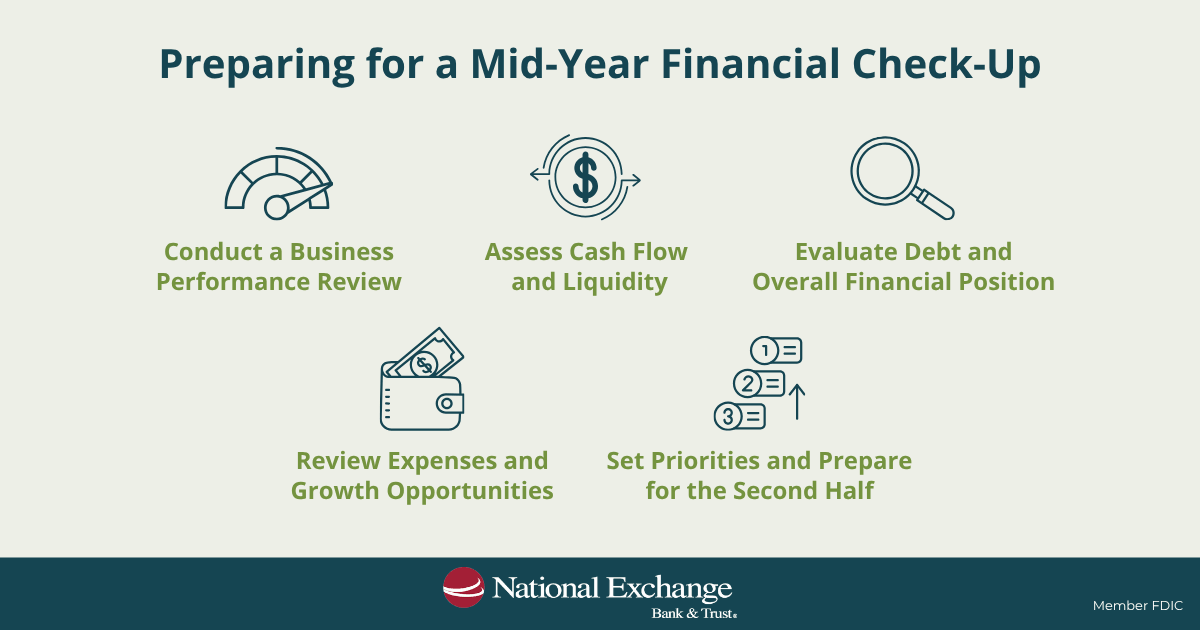
At NEBAT, we recommend a five-step approach for a comprehensive mid-year review:
1. Conduct a Business Performance Review
Start with the fundamentals. Pull your year-to-date financials and compare them against the projections you set at the start of the year.
Ask questions such as:
- Is revenue meeting expectations?
- Are profit margins staying consistent?
- Which products or services are performing best?
- Where are operating expenses increasing?
A thorough business performance review goes beyond surface-level numbers. Look at which revenue streams are performing well and which are underdelivering. Dig into your cost of goods or services and examine whether those ratios are sustainable. Spotting trends now gives you the information you need to make smarter decisions in the second half of the year.
2. Assess Cash Flow and Liquidity
Profitability and cash flow are related but separate conversations. A business can be profitable on paper and still run into serious trouble if cash is not moving through the operation predictably. Mid-year is an ideal time to map out your cash inflows and outflows from the first six months and look for patterns.
Are there seasonal gaps that created pressure on your reserves? Are customers paying on time, or have accounts receivable started to stretch? Review your current reserve levels and consider whether you have enough short-term liquidity to handle unexpected costs or opportunities. Early warning signs of cash flow strain are much easier to manage when you catch them in July than in November.
3. Evaluate Debt and Overall Financial Position
Not all debt is a problem, but all debt deserves periodic review. Take stock of your existing loans, lines of credit and repayment schedules. Ask whether the financing you have in place still makes sense for where the business is headed.
Consider evaluating:
- Current interest rates
- Loan repayment schedules
- Available borrowing capacity
- Opportunities to refinance or consolidate debt
- Cash flow impact of existing obligations
If your business has grown or your financial position has strengthened, you may have new options worth exploring, such as refinancing at a better rate, restructuring terms to improve cash flow or consolidating multiple obligations into something more manageable. Understanding your borrowing capacity heading into the second half of the year also enables you to move quickly if an opportunity or challenge arises.
4. Review Expenses and Growth Opportunities
Mid-year financial planning for businesses should always include an honest look at spending. Identify any costs that have crept up without a corresponding return. Evaluate vendor relationships, subscriptions and recurring expenses to see what is still earning its place in the budget. Efficiency is always key.
At the same time, do not let a cost-cutting mindset crowd out a growth conversation. Are there investments you can make now that would generate meaningful returns in the second half of the year? Whether that looks like adding staff, upgrading equipment or expanding a service offering, mid-year is a logical time to model out those scenarios with fresh data in hand.
Using Business Loans to Support Growth Opportunities
For many businesses, growth requires access to additional capital. Mid-year is a smart time to evaluate what business loan options could help support upcoming investments while maintaining healthy cash flow and operational stability.
Business loans can provide funding for:
- Equipment purchases and upgrades
- Facility expansions or renovations
- Hiring and workforce growth
- Technology improvements
- Inventory increases
- Working capital needs
To explore financing solutions that align with your goals, connect with one of our experienced business lenders to discuss loan options tailored to your business needs.
Business Loan Options Our Business Lenders
5. Set Priorities and Prepare for the Second Half
Now it’s time to translate your findings into clear priorities. What are the two or three most important financial and operational goals for the remainder of the year? How do those goals align with what the numbers are telling you?
This is also the right time to organize your financial documentation. Updated records make you lender-ready if you need to move quickly on a financing decision. Identify in advance whether additional banking support or guidance from a financial partner might serve you well in the months ahead.
How NEBAT Can Help with Your Mid-Year Review
At National Exchange Bank and Trust, supporting local businesses is core to what we do. Whether you need a sounding board for your mid-year strategy, a review of your current banking relationship or access to business lending options that fit your goals, our team is here to help.
From business checking and treasury management to commercial lending and lines of credit, NEBAT business services are built around the needs of business owners in our communities.
Reach out to your local NEBAT banker to start a conversation about where your business stands and where you want it to go.
